Showing posts with label first impressions. Show all posts

Tuesday, June 13, 2017

New Year New School

Mahika started her new school today. It must have been quite an experience for the little girl. New place, new teachers, unknown faces, unknown surroundings, and new friends. But like all new kids, she put up with it rather bravely.

The day started with us all waking up early, getting ready, and starting for school on time. We reached the school well before time to see a whole crowd waiting at the school gate. Various school vans, buses, cars, bikes were parked on the road. All parents with their little ones were gathered together waiting for the gate to open.

After waiting for around 25 minutes, the gate was finally opened. There was a huge rush to go in, just like entering a theatre for a movie. A total chaos reigned for some time where nobody knew which line was for which class, and how long it would take to go in. In the big rush, students and parents were all cramped towards the gate, sweating, and getting irritated by the minute.

But even in that big rush, the little ones were really brave. I couldn't hear anybody crying. Every little one was anxious, and fearful of what lay ahead. But they all were very forbearing and brave. Kudos to the little ones!

As we entered, we could see the school buildings, playground, and the surroundings. We all took our kids to their respective classes and left them at the doorstep.

It was a big moment. My little girl had grown up to go to a big school. Her eyes were so expressive, full of anxiety and fear, yet trying to be brave, and holding back her tears. Although not completely heart-wrenching to see her go, I did feel a little shaken to see her sitting in a strange place, coping it up with everything. Brave sweetheart!!

All parents waited outside the gate for the first day of the school to get over. We formed groups and talked about the school, studies, experiences of interviews in different schools, and remembered our own school time.

Soon enough time was up, and all parents again gathered at the gate. A few first goers returned with crying kids and there was an eerie silence around. Each parent was wondering how his/her kid was.

I picked up Mahika from her class. She did cry for some time on the first day, but was a bit settled as I picked her up. Today, she didn't cry at all. Bless you!

The first hurdle is crossed. More to go. But to start well is half done!

I am proud of you dear Mahika!

Sunday, December 13, 2015

The English-Speaking Rickshaw Driver

Yesterday I boarded a rickshaw to return home. It was a Saturday, around 5.30 PM, and I was
returning from an exciting day.

As we took a turn, the driver asked me why it was so less crowded today, and whether it was because it was a Saturday. I just nodded, not ready to delve in any kind of conversation.

In a few more moments, the driver started talking about how he was learning English from his son and telling incidents about his passengers.

He told me about two Iranian girls who had boarded his rickshaw. One of the girls wanted him to go faster and faster. So his answer to her requests was, "Next time you call me, I'll come on bike."

He narrated how he was learning "good manners" and had a good sense of humor. He narrated another incident of how he replied to one of his customers by saying that he was "at your service."

He also asked me whether I knew who the father of the constitution was. When I answered correctly, he showed me some script tatooted on his right forearm.

He told me right at the start of the conversation that he was learning English from his son. But then he also quoted quite a lot of sayings in English. I thought that either he was too good at his studies to learn so much so quickly, or else he was lying about how he had just started learning.

Frankly, I was a little unhinged.

He probably had really good intentions. He didn't make any untoward remarks. He did seem respectable and honorable. But still I couldn't really be comfortable.

I just couldn't figure out whether he was real or fake, and what he really had in mind.

I still keep on thinking whether it was necessary to judge him. But I cannot help but also think that in today's world, one cannot be too free with strangers, especially those who start a conversation without any reason, and who try to be too familiar and pleasing.

My suspicion made me stop the ride a little further away from home. I didn't want to take the risk of letting him know my home.

It was kind of a muddled experience.

Wednesday, August 27, 2014

Review: The Golden Notebook

I admit, I took up the novel, The Golden Notebook only after reading about Doris Lessing's death. And I
have a feeling that that must have happened for such other writers too.

I started the 500 plus pages novel with some trepidation. It's been awarded the Nobel Award for Literature and I was sure it was going to be a bit deep and difficult to understand. I was also not sure how soon I would be able to complete it. Moreover, the synopsis promised to be intriguing and and frankly a bit tedious and complicated.

I had expected the novel to be a commentary on life, how people lived in the 1950s. And perhaps it is. But I just could not relate to it. Let me get into the details.

The story is about Anna Wulf. But the way the novel starts, I thought it was about Molly. It starts with Molly, her son Tommy, and her ex-husband Richard. The initial part is focused on these characters and it's only when Anna goes back home after visiting Molly (when the story begins) did I realize that it was Anna the protagonist, not Molly.

Anna is a single-novel writer whose first novel has earned tremendous success. She is living off the royalties of the book. She is a divorced single mother of a twelve year old girl, Janet. She has a huge flat and rents out the upper room to people. Ivor, Ronnie, and the last one Saul Green are a part of the story and affect Anna's live in a peculiar way.

The novel is divided in different parts called "The Notebooks" and "The Free Women". There's one part called "The Golden Notebook" about which I will try to talk about later. The "Notebook" parts are the diaries that Anna maintains, four of them. Red, blue, yellow, and black. Frankly, I still haven't understood why four of them, and what each one contains.

The dairies are full of her nostalgia for the life that she spent in Africa, especially the hotel in Mashopi. Later they move on to minute details of her day to day life, dealings with her renters, Molly, Janet, her boyfriend(s), and her work. I got tired after a point. It was too much details and too many things. Anna keeps on talking about the same things again and again and it becomes tedious and frustrating.

The "Free Women" parts are third-person narratives of what is actually happening with their lives. That was much more interesting that Anna's diaries.

I haven't understood what Doris achieved by this novel. Perhaps she didn't want to achieve anything at all. She was trying out a new form of writing. But then, why write so much then, over 500 pages?

I couldn't understand Anna. She just goes on living each day without doing anything...she just writes in her diaries, feels depressed all the time, is nervous and is always waiting for her boyfriend. She cooks for him, goes grocery shopping, reads newspapers, and overall just stays put in her flat. I wonder if this really was the life of women in the 1950s. It's no wonder that Anna feels depressed and lonely.

Molly and Anna call themselves "free women". But always are they talking about men, sex, affairs, and overall waiting for love to happen. Are they really free then? Anna especially seems a psychotic woman, who cannot live in the present but in her past and in her wild thoughts of nervousness and jealousy. It is a rather disturbing character.

I didn't like Doris's language too. There are just too many words. I haven't liked her style where the adjectives she uses to describe people, events, objects are really her own thoughts. She wants the readers to feel the same feeling and emotion that she has felt. It's like she spells out what you must feel as you read, no space for interpretation. Her words are very strong and overwhelming.

Doris has repeated the same story again and again in the novel. Anna writes a story that reflects her relationship with Molly. It is not hard to see the similarities and I kept wondering what's the need of the double stories. I still haven't understood why so many layers to tell the same story repeatedly. Or I am a dumbo and cannot understand the depth of the novel.

The synopsis says that the "The Golden Notebook" is what will help Anna to recovery. But when I read it, I got more confused. I am now not sure whether the part about Saul Green should be taken as the events that really happened in Anna's life or whether it's a story that Anna writes. If it's a story, then Anna doesn't need a recovery. She is fine already. If it's real, then it's Anna who needs to see a doc to get out of the mental mess.

Doris's language is very strong and at times weird. I felt at a loss with her punctuation and writing style. Pages and pages of a single paragraph. it took my breath away to finish one paragraph. It would have been so easy to break down the words in different paragraphs. But perhaps I am speaking from the point of view of minimalism. (My profession comes in between my understanding of Doris's writing style.) And she has used sentences such as this: "However." Now what does that mean? I really could not get it.

Overall, I heaved a sigh of relief that the novel was finally over. I really had high expectations from it because it won the Nobel. But to tell the truth, I was disappointed.

Does such writing get Nobel? Then why not the essays that we wrote during our graduation and post graduation? May be because the essays we wrote were too simple to understand and did not contain any reference to communism!

Friday, June 14, 2013

Growing Up

What does it take to have a better life? Love, friends, family, work, peace of mind, happiness, safety and security, togetherness, understanding partner, overall stability, people who treat you well and never let your down?

I think all this together. Man is a rather selfish animal. Apart from food, water, sleep, and physical well-being, there are so many more things that man requires to survive. We need love and acceptance from our partner, friends, colleagues, relatives, acquaintances. That's one of the most important requirements apart from the basic needs. If that's not fulfilled, if you are not accepted as you are, as the person that you are, you will always be dissatisfied, frustrated, and driven to craziness.

As you move upwards in life, you grow. People around you grow and change. You metamorphose into someone that you never thought of as you started your journey. A simple example is how you are at the start of your career. Ten years down the line, when you sit back and look back at the time that's gone past, would you say you had foreseen yourself there where you are? Very few can. Very few have such chalked out careers. But all will certainly have matured over those years. Each one would have learnt so much and experienced so much that you would definitely agree that you are someone who was not so ten years before.

Today when I was chatting with a very good friend, I was talking about what I was when I started my career. I was so naive, so untamed, so untrained. I was so coarse. Today, after eight years, I know I have grown. I have experienced different types of people and learnt to deal with them. I have learnt so much technically, something that I never could have thought of eight years back. And I am so much more confident today.

I always remember Elizabeth Bennet from Pride and Prejudice. Elizabeth remains unfazed by the pomposity and grandeur of Lady Catherine's home and person. A few years back, I used to feel diminished even thinking of facing and interacting with highly technical people, developers, and engineers. I used to feel that I would never be able to face them because of my lack of technical knowledge. But today, like Elizabeth, I feel unfazed. I can meet them with an equanimity which has come with experience and learning. And I am happy about it.
Growing up also includes an important aspect of knowing what you don't know. Realising what you are not good at and striving to achieve an acceptable level of knowledge in that.

I had attended a training in April in which I learnt to eat the ugliest frog first. In simple terms, it means that if there's something that you find the hardest to do, you should always do that first. Get that out of the door and the work will become much lighter. In some ways, I've started using that in my work as well as personal life. It's working too. :)

That's how things are currently. I am growing and I am happy.

Sunday, February 24, 2013

Fights

Yeah, that's what you'll experience when you visit the Sinhagad Fort. That's what we experienced too.

Sinhagad is located around 30 kms west of Pune and reaching there is pretty easy. You can either take a bus from Swargate, Deccan, or Shaniwar Wada bus stands. These buses go till the foot of the fort. You need to climb up from the foot. Otherwise, and the better option if you do not want to be tired from the climbing, you should hire a car, or even better, take your own car.

The fort lies around 10-12 kms from the village that's at the foot, called Donje. You must pay a toll of Rs. 20 or 50 for a two or four wheeler respectively as you start climbing. If you have got your own food, you also need to pay a nuisance fee of Rs. 100.

The first five or so kms are smooth and enjoyable. The middle patch is excruciatingly painful. It is completely neglected and the road has been washed out. It's full of potholes and worse than a village road. the last 5 kms are again very good, and you heave a sigh of relief as you see the smooth road.

As you park your vehicle in the parking lot, lots of ladies with "dahi" and "taak" will literally follow you up till the fort. They just won't let you go. As you visit the different points, they'll keep on asking you if you'd like to have curd or buttermilk. Even if you keep saying no, they'll persist. When you finally decide to have some, there'll be a fight between a couple of them about who "caught" the customer first.

Their loud discussions are enough to distract you and make you wonder why you ever selected that lady. But don't bother, it's nothing to do with your selecting her. It's the other way round. They select the customers they want right from the parking lot, and follow you till you have to have the curd and buttermilk from them. If you don't, there will be a big fight.

Obviously, the price seems too much, especially after the fight. After this first haggling, you'll again have to face various other food providers who are trying to catch you. You'll get a simple meal of pithla-bhakri there. But even that is enough to start the whole fight all over again.

Thankfully, the food is decent wherever you have it. Remember to order the kanda-bhaji first and then pithla-bhakri. And lastly, have the dahi and enjoy the meal.

If you can ignore all the petty fights, it's a good half-a-day outing that you can enjoy. Especially when the heat is mild and there's a gentle breeze flowing all the while, making the sun all the more bearable. Despite all the troubles reaching there or the fights at the top, you'll certainly enjoy the outing.

Monday, August 6, 2012

Behind The Wall

My office is very close to the jail. The office canteen overlooks a wide patch of land where all women convicts toil hard in the day. As the days have passed, the brown, coarse patch has turned into a green, lively field.

Everyday is a new day to observe these women in the field. When we moved to this new facility, it was a novel place for us all. We were overjoyed to see the vast fields before us and the open skies. We moved in the winter months and were glad to sit in the weak, winter sun and get some sun-bath. The early morning ritual of a hot cup of chai in the sun to warm ourselves was coupled with the gazing and observing of the fields before us.

As winter gave way to summer, the oppressive heat became unbearable. We tried to avoid the open canteen and remain inside in the air conditioning. Even as we had to go to the canteen for our lunch, we grumbled about the brutal heat waves that made it impossible to sit there. Only as the afternoon waned, we stepped into the canteen for a cup of evening chai.

Rains have come very late this season. Long, dry summer was very adamant and troubled everyone with its dry winds and insufferable heat. Finally as the rains have arrived, a fresh breath of life has been given to all. Everyone has also given a sigh of relief that the water situation for the entire city will improve.

During all this time, with the changing landscape, the fields and the workers have been constant. In the harsh summer afternoon, we could see them under the trees. All ladies in green saris toiling hard in the heat. As monsoon approached, they started tilling the fields and then waiting for rains. Two months into the rainy season, their fields have blossomed into green vegetables, and other produce that they will sell.

Every day, for me it is a kind of a routine to look out at the fields and see the convicts working. Sometimes, it is hard to believe that all those ladies working in those fields are convicts. The tremendous efforts that they put into their work is a truly extraordinary.

Perhaps some of them could have been convicted for petty crimes, some might have done gruesome crimes, while a few could also have been convicted wrongly. But they all have the same routine now, same lifestyle. A few could have been from rich families, while others from poor families. But in the world behind that big wall, they just are all the same. Neither poor, nor rich; neither educated, nor coarse, just plain criminals who are all on an equal level.

Or so it seems! Inside the walls, what happens one wouldn't know. There would be a hierarchy even among the hardest of the criminals. They might perhaps still be bullying some weaklings in the group. Perhaps only before the wardens they behave themselves while without a watchful eye, they go back to being the ruffians that they are thought to be.

Each one of them would have a story to tell. Of why and how they landed up in the jail. How they have their families behind them, how their kids might be surviving without them. It must be difficult for them to be without their kids and families.

I always wonder what each one of them must be thinking of when they are serving their sentences. Do they feel ashamed of what they did? Do they feel good that they did what was right? Do they feel stuck in that little world behind the big wall? Some of them could be waiting for the end of their sentences so that they go out and lead a better life. They have perhaps learnt from their mistakes and during their time in the prison, they have come to understand what life really is.

All in all, for me it is an everyday experience of seeing the ladies toiling in the fields and doing something that not all could boast of in an urban landscape. But then, they also have done something that not all would normally do.

Wednesday, May 2, 2012

Visiting Vishrambaug Wada

Vishrambaug Wada, is a nice old style wada situated in the heart of the Pune city. For shoppers who are well-known with Tulshibaug won't find it difficult to find this place. It's just opposite the entrance to Tulshibaug on Bajirao Road. Lot of confusing names for the newcomer in Pune. But don't worry. Just hop into a rickshaw and ask the rickshaw-wallah to take you to Vishrambaug Wada. You'll be alighted right at its entrance.

Inside of Vishrambaug Wada
So...to start with the history, this palace or Wada as it is called in Marathi, was built in 1807 at a cost of Rs. 2,00,000, which was a whooping cost at that time. It was owned by Peshwa Bajirao II, who stayed there for around 11 years before he was imprisoned by the British.

In 1821, a Sanskrit school was started in Vishrambaug Wada. Government Engineering College (now called COEP), Deccan College, Pune University, and Agricultural University were all had their humble beginnings here in Vishrambaug Wada.

A well inside Vishrambaug Wada
An interesting placard in the Wada mentions that William Wordsworth had written to the Public Works Department (PWD) complaining of the unhygienic conditions of the Wada at that time. I am really not sure if this could be true. Need to verify that. Nevertheless, it does give a different charm to the Wada.

At this Wada are now some municipal offices such as the Birth and Death Registration Office, Post Office, and a few shops are also operative.

What is also of some interest is a very small showcase of old buildings and structures in Pune, right from Council Hall, Gokhale Hall, Kasba Ganpati, Mandai, and various other notable structures. Miniatures of all these noteworthy buildings are on display. But this showcase seriously needs a makeover. More information about these buildings, clean and bright environment, old photographs, and many more interesting facets of life in Pune in the 18th and 19th centuries will make this a veritable source of information. This display is for free now. But I wouldn't mind paying if they upgrade it.

Also. if they take some serious restoration work for the Wada, make a few more rooms open to the general public by providing them information and entertainment, I am sure it will work wonders for not just tourism, but also for our glorious history.

Wish someone does take some efforts!

Friday, April 13, 2012

Doing Those Things

I have again started following a couple of Marathi TV serials that are there on air. I like them. Both these, I wish I can follow everyday. But I know that is never going to happen. Firstly, I don't get to watch what I want on TV when I am home. And secondly, we usually don't reach home by the time the serials are shown. But both serials are good: उंच माझा झोका and एका लग्नाची दुसरी गोष्ट.

Both deal with different subjects, both are directed well, and the most important point is that they are not about the fighting, conniving, saas-bahu stupid themes.

Apart from that, I am also reading different types of books. If I am reading fiction at a point, I complete it and move on to something like autobiography or philosophy, or facts and mythology, or even something as simple as children's book. It's exciting.

And one thing I have done plenty is thinking, thinking, thinking. Speculating, rethinking, regarding, judging,  doubting, understanding, surmising, supposing, recalling, grasping, fathoming, realizing, theorizing, suspecting, concluding, hoping, awaiting, assuming, and getting exhausting doing all this.

That's how life is at the moment! 

Thursday, February 16, 2012

Waiting For Dinner

Date: February 14, 2012

Day: Tuesday

Time: 8.45 p.m.

Place: Hotel Greenpark

What's the first thing that you see around? That the parking lot is full. So much so that you start wondering if you will ever get a place to sit. And of course, there's no place. There's a huge waiting list.

Knowing that it's the same situation in every other decent restaurant, you resign yourself and enlist yourself for getting a place for two. Now what comes is the big wait. You keep a track on how it will take and end up getting answers such as: "Ma'am, it's page 3 that's going on. You are on page 5. At least 45 mins more."

You deliberate whether sitting out the 45 minutes would be a better option, or finding out another restaurant would be. Eventually you realise that you will spend the same time in some other restaurant. So, why not here.

So, what else do you do in that time but observe things around you. You see so many around you waiting for their turn. You see kids playing around, mammas behind those kids making sure they don't get hurt. You see couples waiting, groups waiting, and waiters waiting too.

Eventually realise that you can divide all the people in some groups. First group is that of the "young" couples. Now let me tell you that "young" doesn't mean by age. "Young" means the couples who have spent very little time together and who are in various degrees of awkwardness and comfort with each other, as well as with the society.

The couples who fall in this category have not had a lot of experience in going out with each other in public. These might be couples who are not sure they are in love, whether they are destined to be together, or whether they really serious enough to think about each other as partners. They may still be doubtful. Nevertheless, they are not averse to trying it out. So, when they are waiting for their turn, they are cautiously looking around to see if they see someone whom they know. They keep on glancing here and there in the hope that they are not caught by some acquaintance, because they probably have not informed their guardians/parents that they are out for dinner with someone. They also are not sure if they should be showing any kind of togetherness to the partner. They are nervous, and they are eagerly waiting for getting a table so that they get the privacy they are looking for.

In this category also lies the "expectant" couple. This couple is on the brink of being committed. They are waiting eagerly for their turn to get the privacy and be done with the magic question. Till they get that table, they are just a bundle of nerves, waiting to be exploded.

The other category is the newly married couples. You can find these easily. They are the ones with the girl looking around nervously, hoping not to find anyone she knows. She is yet uncomfortable being out with the boy. Although happy and looking forward to the privacy of their table, she is not sure if she should be feeling good that they have come out for dinner on a day such as Valentine's Day, or if she should think that celebrating such things are just tacky. She is best waiting for the moment when they can retreat to their world of privacy when they get a table. The boy on the other hand is feeling extremely proud of getting the girl out for dinner on such a lovely day. He is much more at ease with the crowd around him.

Then there are couples who have been there and done that. It's not new for them to go for dinner on such an occasion. But they have still not lost the charm in it. They are very comfortable with each other and enjoying every moment.

You will also find families who have come out for dinner. Mother-father-kid/s, all together. The kids may be young or even a bit older. For the parents, it's an occasion to enjoy some time together, do something different than the routine. Even if eating out might be routine, the charm and magic of the day is still to be celebrated.

Lastly, there would couples, though really very few in numbers, who have come for dinner, just for the sake of it. But they are really very few.

In all this, you'll find the ladies wearing a variety of clothes. The most modern chicks would be wearing the most fashionable dresses. There will be ladies who flaunt by wearing all rich sarees. There are casual dressers, who are more happy to enjoy the moment than worry about clothing. Some would be neatly dressed, who enjoy wearing good clothes without flaunting them. For them, comfort and feel-good are the factors that are most important. It's actually a fashion parade out there.

For guys, mostly, it doesn't matter. They are more worried about the immediate...food, and when they can get a table.

Intermittently, you can also see couples coming out of the diner, looking happy, relaxed, enjoyed, and fully satiated. They are happy that they enjoyed their privacy, their food, and most important, they are happy that they were lucky to get a table so early and not wait so long for their special dinner.

And suddenly, they call your name and you are finally getting a table all to yourself. It's time to turn your attention to more important thing...what to order!

Wednesday, February 8, 2012

On Watching Agneepath

...the new Agneepath, starring Hrithik Roshan.

It affected me in many different ways. We were around 10-12 minutes late for the movie. We missed the start. But I don't think that mattered much. I have not seen Amitabh Bachchan's movie and so this version was totally new for me.

The first thing that stuck me was the tremendous violence in the movie. It is downright nerve-wracking. I was on the edge of my seat and was not sure I had done the right thing by coming to watch the movie. The movie starts with violence where Vijay's father is murdered by Kancha, the main antagonist. It is an incident that drives the movie. It drives each and every move that Vijay makes. It sets a grim tone to the whole movie. There are almost no light moments; emotional, yes; but lighter moments...I really cannot remember.

Vijay's father, a school master had tried to oppose Kancha's dream of turning the village in a drug center by renting the lands of all villagers. Kancha successfully removes the thorn (Vijay's father) from his way, while the whole village celebrates that they can now freely help Kancha. Kancha lures them that their lands would be used for a salt factory and they would get money out of it. This grim victory is actually the downfall of the villagers. They win the battle of doing away with the schoolmaster and in turn lose the war of having a happy and prosperous village. They literally walk towards their downfall.

When Vijay's father is murdered, his heavily pregnant mother is shown being trampled at the feet of the angry village people. I was hoping that they wouldn't show her bleeding to death, and thank God, they didn't! Eventually, the mother and son escape to the big city and arrive in a basti. The mother goes into labour pains and a daughter is born.

Soon enough, Vijay-a boy of 12 years, witnesses a murder by Rauf Lala, and lies to the police about the murderer. Vijay  also murders the police officer who tries to get him tell the truth. His mother severs all her ties with the son and moves out of his life to lead a life of her own with her daughter. We now see a Vijay that's all grown up handsome and all with a girlfriend, who works as a mafia leader for Rauf Lala. Rauf is not just a drug mafia, but also a human trafficker.

As Hrithik Roshan entered as the older Vijay, I found it very similar to Fiza, a movie directed by Khalid Mohammed. Fiza is the story of how a sister seeks out to find her brother-a troubled boy who goes on to become a terrorist. Vijay in Agneepath too has had a disturbed childhood that has made him a violent mafia leader. I think I made that comparison more because Hrithik Roshan has played the troubled boy in both the movies.

I won't give away the whole story here. But what with songs in between, more murders, mass killings, double dealings, we are finally led to a climax, that's again a replication of what we saw in the beginning.

The once happy and prosperous village that Vijay and Kancha hailed from, has now turned into a barren land. Death, disease, poverty, unhappiness, and distress is what you see and it makes you feel all the more horrified and hollow.

At every violent, illegal, unhealthy event in the film, I was more and more engrossed with feelings of futility, hopelessness, dread, and loss.

What also aided these feelings was the tremendous background music given by Ajay-Atul, the Marathi composers, who have done a fantastic job. The tension, the evilness, the futility, the murderous villains, the dark atmosphere is all enhanced by the background score. It increases your heartbeats, it gives you the chills, it makes you all nervous. Salute to the two.

The duo have also provided the music to the songs in the movie. One particular song affected me in a totally different way. The song is "Abhi Mujh Mein Kahin" and shows how Vijay enjoys his time with his sister and girlfriend together. The lyrics are really nice and the song made me cry. The emotions of Vijay meeting his sister after 15 years, and how he had lived each unhappy day to enjoy this one happy day in his life resonated with me and brought out completely different feelings. I don't know why that happened. But I cried remembering my parents, how sometimes I miss them very much, how they miss me, how we are unable to be with each other in our moments of distress and happiness too. I thought how each day I hope to have them with me and meet them. I cannot describe all that I felt as I cried dearly. It was a very, very distressful moment for me. I miss my parents a lot. A lot.

My life has been so very different since my marriage. The song brought it all out. I was quite disturbed for that evening and night. The violence and this song of the movie have made a major impact on me.

Agneepath has really been a different experience for me. Unforgettable!

Sunday, February 5, 2012

Diveagar and Srivardhan

If you want to enjoy the beach, head to Diveagar. The beach is safe, beautiful, and vast. The waters are comparatively cleaner.

Map
Routes to Diveagar

1. Via Tamhini Ghat
This is the commonest and probably shortest route to go to the Kokan area from Pune. From Chandani Chowk, take the road towards Paud, Mulshi, and follow it up to the Tamhini ghat. After crossing the ghat, you have to join the National Highway 17, the Mumbai-Goa Road at Kolad.

2. Via Khopoli-Pali Road
From Pune, you take the Mumbai Expressway. Take the Khopoli exit. From Khopoli, take the Khopoli-Pali road. I don't know much about this route. We did not take this route. With this route, you get out on the NH 17 somewhere near Kolad.

3. Via Khopoli-Pen Road

From Pune, you take the Mumbai Expressway. Take the Khalapur exit (go past the Khopoli exit), and take the Khalapur-Pen road. This is a beautiful drive, though a bit lonely. It's a stretch of 25 kms and takes approximately half an hour. There aren't any shops or garages on this road. So, make sure you have an extra tyre with you, and also get to know how to change a punctured tyre, just in case. This route goes directly in the Pen city right through the market. Cross the town and join the Pen-Alibaug road at the other end of the town. After around 5 kms, take a left at the Wadkhal naka. That's where you join NH 17.

Eventually, all roads lead to NH 17. :)

On NH 17, you will pass all small and large villages and towns. The important towns on the way are Nagothane, Kolad, Indapur, and Mangaon.

To go to Diveagar, you must take a right at Mangaon. Just after crossing the ST stand on the right hand, a small road is seen on the right. It can easily be missed, so keep a watch on it. Interestingly, the road points to only Morba, the next village on that route. But that really is the turn that you need to take to go to Diveagar, Harihareshwar, and further down south.

From the Morba road, you must cross the Morba-Sai ghat. After Sai (a village), comes Mhasla. At Mhasla, you need to take the right turn to go to Diveagar and Srivardhan.

4. From Harihareshwar
Marine Drive: Harihareshwar-Diveagar
If you have visited Harihareshwar first and are coming to Diveagar, the route that you take is through Srivardhan. This road is called the Marine Drive. It's no comparison to Mumbai's Marine Drive. Initially, you might just feel that why the hell is it called Marine Drive. But patience and you are appropriately rewarded. The road at one point goes on to become parallel to the coastline and it definitely deserves to be called Marine Drive.

Srivardhan

Shreemant Balaji Vishwanath Peshwe
Srivardhan has a great historical background. Unfortunately, nothing of this great history is now visible in Srivardhan. It's the birthplace of Shreemant Balaji Vishwanath Peshwe, the Prime Minister of Chatrapati Shahu Maharaj. But what remains now of the house in which he was born is nothing but a statue.

We had hoped for at least some sort of museum or some relics that would help relive history. But nothing at all.

Srivardhan beach
I guess, Srivardhan is now more known because it is a Taluka place. It was bustling with activity even in the afternoon when we reached there. The traffic was pretty heavy and had to be monitored by traffic police.

Again, the beach at Srivardhan is beautiful and quite long. We were there in the afternoon and did not find anyone else on the beach. Perhaps it's busy in the morning and evenings. But, it's better to check with the locals about how safe it is.

We did not stay at Srivardhan. So, I cannot provide much information about the places to stay and eat at Srivardhan. However, I am sure you will be able to find homemade food and rooms that are let for staying.

Diveagar

Diveagar main road
Diveagar has recently, rather, since 1997 suddenly appeared on the tourist map. Earlier, it must have been the same old sleepy coastal town, that not many knew about. In fact, Borli-a town around a kilometer away from Diveagar has been the market center.

What has made Diveagar famous is a golden idol of Lord Ganesha that was found buried in a trunk in a field. The story goes that in 1997, a peasant was digging in a field and he stuck gold. Literally! He found the buried trunk containing the idol of Shree Ganesh. The trunk also contained some ornaments for the idol. Diveagar suddenly warmed up to the blessings of the Lord, and lo behold, it is now a much sought after place!

The gold idol is placed in a Ganesh temple not far from the site it was found. The temple is very much in the center of the town and there's a parking lot just opposite the temple, where all tourist buses are parked.

Diveagar Beach

The beach in Diveagar is beautiful. It is long, calm, and clean. In the evenings, a vehicle is available that aids you para-sailing. I cannot give it a name. You are tied to the para-sailing equipment and a jeep takes you till a certain point, with you are in the sky around 35 feet above the ground. People assist you with the equipment and also help when you touch down. It might be fun. I didn't try it out.

Diveagar beach
In the mornings too, the beach is beautiful. You can take long walks on the beach and enjoy the cool waters. Of course, be it in the morning or evening, do keep a watch on the tides. As always, the high tide waters rise drastically and might be dangerous.

You can have nice coconut water, bhel, kadak chai, or also buy a few toys at a couple of hathgadis available there. You can also enjoy a water ride in the boats available. Do make sure that they provide you with life jackets before you go for the ride.

Where to eat at Diveagar?

Two places really...Bapat Khanawal and Paarkar Khanawal.

For vegetarians, you just cannot miss Bapat Khanawal. The food is awesome. And the most important part is that you get to have modaks that you just cannot miss.

To go to Bapat Khanawal, you have to cross the Ganesh temple, and keep going straight ahead. The lane is full of Bapats. There you will see a small board explaining that the Bapat Khanawal is the 5th gate on the right. It's damn easy to miss the gate. So, better count them correctly! Because, if you miss that, you are going to miss an awesome food offering.

Mind you, you need to tell at the Bapat Khanawal in advance before you go for lunch or dinner. You cannot just barge in and sit down to eat. Also, when you are asked to come before a certain time, do make sure you go before that time. The Bapat Khanawal can take only around 100-150 people to eat at a time and you should not miss it. They close down at the decided time. Don't miss the right time.

If you want to have modaks, you must also place an order for that. Place an order of how many per head you will have. They make it in that much quantity and you cannot have more than that. But, seriously, do NOT miss the modaks.

For non-vegetarians, Paarkar Khanawal is the best place we thought. Awesome fish you get there. Pompfret, surmai, chicken is all available there. At Paarkar Khanawal too, if you are going in a large group, it's better to inform them in advance. Otherwise, it really gets crowded and there's a big waiting list then. Vegetarian thali is also available here. So, for groups that have people who are vegetarians and non-vegetarians, this is a really good place.

All in all, other than eating and visiting the beach, there's not much to do in Diveagar. So, relaxing is best done here.

Staying at Diveagar

Innumerable bed-and-breakfast places are available. You should find a place to stay easily. However, if you are going for a weekend that is kind of a long weekend, it is better to book rooms before you go. After noon on a weekend, you might find it difficult to find a place.

Tips for Visiting Diveagar
  • Keep first aid, sunscreen lotion, caps, old newspapers handy. All these are useful at times.
  • Keep a torch handy as night falls.
  • Depending on how much time you want to spend on the beach, a day and half is more than enough for Diveagar.

Happy vacation!

Tuesday, December 27, 2011

The Start

It's really the distance. It's always told merely 200 kms. But it turns out to be really 250 kms. And you just keep on driving and driving. Mile after mile you cover hoping that the next turn will be the last turn, but it turns out to be just another turn.

Perhaps, it happens only with me. But it never turns out that I leave for a journey at a pre-decided time. More often than not, I tend travelling for a longer period of time than required.

As I traverse the known roads, the destination seems to be close by. I travel those roads with a feeling that four-five hours is nothing and I'll reach the destination soon. Every turn is familiar and I am happy that the journey has finally started.

As miles pass after miles, lunch hour approaches. I get down to stretch myself and to have lunch. If it's a pre-decided lunch stop, you the taste and food. It it's not, I am in anticipation of what I'll finally get before me. After the sumptuous, or not-so-good food, you are back on road.

As the journey progresses, I start losing patience. The journey seems to be never-ending. Turn after turn and mile after mile is crossed. I keep looking at the odometer counting the kilometers that I have covered.

At last after being completely tired and woebegone, huts and small houses are visible. The town that we have decided to stay finally arrives. My fears that the town may not actually exist are thankfully not realised. I get down and stretch myself.

Finally, one part of the journey is over. In fact, the Start has finally ended.

Monday, November 21, 2011

Responsible

When things do not work, I realise I am responsible for them. When I screw up things, I know I am responsible.

But when people don't behave well with me for no apparent reason, but just that I exist...even then am I responsible?

My one action can bring about so many changes. It has changed so many people, it has perhaps broken so many hearts...severed so many relations. Is it after all worth it? More than that...I shall always have this constant gnawing at my heart that it's all my doing.

But what really is the issue? I don't know. I cannot fathom. I cannot understand why it is so difficult to make the other person feel comfortable and loved in a group. I cannot understand why some have not bothered to include me in. Why do some people still prefer a ghetto? What's so disgusting, so bad about me that I get alienated?

Why do I not get enough power, recognition, freedom to do things? Why is everything so unhealthy? What have I done after all? I cannot understand. I cannot make head or tail of some situations.

But in all this, I do feel responsible for making a mess. Or perhaps starting a mess. It's going to be one scar, one guilty feeling that won't be ridden off.

Saturday, June 18, 2011

Ajanta

Ajanta Caves
Ajanta, another World Heritage site, is something that cannot be missed. Situated at around 100 kms away from Aurangabad, you need the whole day to travel to Ajanta, visit the caves, and return to base camp.

The village near the caves is called Ajintha (अजिंठा) and in Marathi the caves are called अजिंठा लेणी. Ajanta caves are 30 rock-cut cave monuments dating from 2nd century BCE.

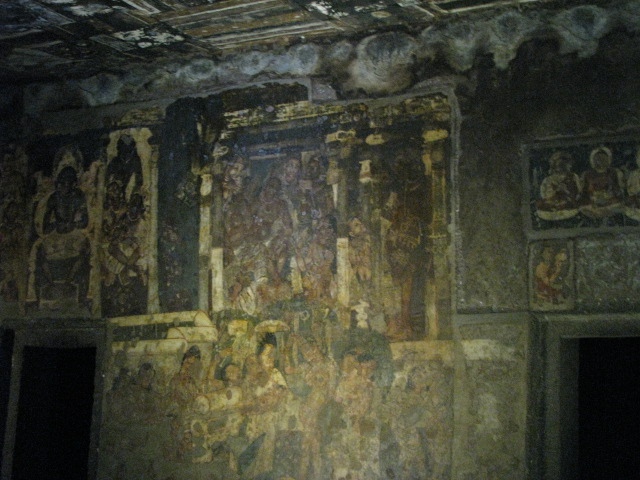
Ajanta caves include paintings depicting the Jataka tales. The paintings and a few sculptures are considered masterpieces of Buddhist religious art.

History

The Ajanta caves were carved out of a horseshoe-shaped cliff along the Waghora river. They were used by Buddhist monks as chaityagrihas (prayer halls) and viharas (monasteries) for about nine centuries, and then were abruptly abandoned. The walls of the caves are covered with beautiful paintings and sculptures of Buddhist origin. They fell into oblivion until they were rediscovered in 1819.

(Re)Discovery

Ajanta caves were discovered by John Smith, an army officer in the Madras Regiment of the British Army in 1819 during one of his hunting expeditions.

Number of Caves


There are 30 caves, with mostly been completed. A few caves are unfinished. A pathway is scooped out from stone and runs as a crescent by the caves. From this, one can have a glorious view of the ravine below.

What can you see in the caves?

The wall paintings illustrate the events in the life of Gautam Buddha. Stories and scenes from the Jataka Tales are brought to life on the walls.

Waghora River Valley
Why Ajanta?

Ajanta lies on the ancient trade route from the Arabian sea to the Deccan plateau. The Buddhist monks found the peace and seclusion they were looking for in the cool ravine of the Waghora river. With trade centers of Jalgaon and Aurangabad close by, the monks could go to these places to collect alms and return to the quiet of the caves.

Moreover, the texture of the granite rock in layers made it easy for the sculptors to cut the rocks with their instruments and for painters to paint.

How were the Paintings done in such Dark Caves?

Painters used stick torches to light up the caves. Mirrors were used to reflect sunlight into the dark caves. Skills were passed down from father to son. New techniques, tools, and new ways of handling paint and chisel were also invented.

Colours Used

Local colors available from mountain rocks and soil were used. The main colours used were yellow ochre, brown ochre, lamp black, white, and lapis lazuli (blue). Lapis lazuli was imported from Northern India, Central Asia, and Persia. Green was created from lapis lazuli using Indian yellow ochre.

Techniques of Painting

The paintings were executed after elaborate preparation of the rock surface. The rock surface was chiselled and grooves were made so that the layer applied over it could be held in an effective manner. The ground layer consisted of a rough layer of clay, cow dung, mixed with rock-grit or sand, vegetable fibers, paddy husk, grass, and other fibrous material of organic origin on the rough surface of walls and ceilings, thoroughly pressed into the rock.

A second coat of mud and ferruginous earth mixed with fine rock-powder or sand and fine fibrous vegetable material was applied over the ground surface. Finally, the surface was finished with a thin coat of lime wash. Over this surface, outlines are drawn boldly. The spaces were filled with requisite colours in different shades and tones to achieve the effect of rounded and plastic volumes.

The colours and shades utilised also varied from red and yellow ochre, terra verte, to lime, kaolin, gypsum, lamp black and lapis lazuli. The chief binding material used here was glue. The paintings at Ajanta are not frescoes, because they are painted with the aid of a binding agent. In frescoes, the paintings are executed while the lime wash is still wet which, thereby acts as an intrinsic binding agent.

Not-to-be-Missed-Caves

Caves 1, 2, 10, 16, 17, and 26 should not be missed.

We visited the caves starting from cave number 1. But I read it recently, which I found really sensible, that you should start with the last cave first. Thereby, you end at cave 1, which is also the exit point.

But let me caution you for this route. Make sure that you leave enough time in hand for the caves 1 and 2. Usually, as we start, we spend more time in the beginning. As time flies by, we tend to skip caves, or hurry across the numerous paintings and sculptures. That would mean that you have very little time for caves 1 and 2. Make sure you avoid that mistake.

I am still going to describe the caves as we visited them.

Cave 1

Padmapani
This is the most important cave of Ajanta and has elaborate carvings on its facade. There are scenes carved from Buddha's life and also decorative motifs. There are three doors, central, and two side-doors. Two square windows are carved between the doors.

The walls of the hall are nearly 40 feet (12 m) long and 20 feet (6.1 m) high. Twelve pillars make a square colonnade inside supporting the ceiling, and creating spacious aisles along the walls. A shrine is carved at the rear end of an impressive, seated image of the Buddha, his hands being in the dharmachakrapravartana mudra. A group of the master's first five disciples is also shown.

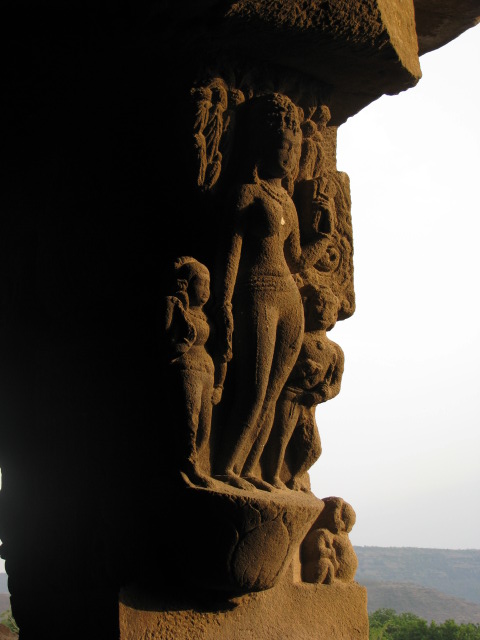
The walls are covered with scenes that are mostly didactic, devotional, and ornamental. The themes are from the Jataka stories (the stories of the Buddha's former existences as Bodhisattva), the life of the Gautama Buddha, and those of his veneration. One pillar in the central right row has a remarkable carving of four deer in different positions sharing the same head that seems to belong to each one of them.

Vajrapani
The doorway of the antechamber of the shrine is flanked by two Bodhisatvas: Vajrapani, holding the thunderbolt on the right, and Padmapani, holding the lotus on the left. Vajrapani is richly bejewelled and leans gracefully against an attendant. Padmapani's eyes are lowered in meditation, his face showing depths of spiritual calm born of compassion for all living forms.

The sidewalls of the antechamber show two scenes from Buddha's life: his temptation by Mara just before his enlightenment, and the miracle of Sravasti, where the Buddha multiplied himself into thousand images.

Above the left porch is the scene of Three Signs (a sick man, an old man, and a corpse) that Buddha saw outside the palace that led him to become a monk. Other tales of the life of Buddha from the Jataka Tales are depicted on the walls.

Cave 2

Paintings in Cave 2
Cave 2, very similar to cave 1 has robust pillars, supported by ornamental designs. The facade of this Mahayana monastery cave shows the kings of Naga and their entourage.

The hall is supported by four pillars making colonnades parallel to the walls. A glorious mandala dominates the ceiling and is decorated with humans, animals, birds, flowers, fruits, semi-divine forms, and abstract designs. The ceiling gives the effect of a cloth canopy, right down to the sag in the middle.

Jataka tales are abundant in the wall paintings. These tales inform us of of Buddha's teachings and life through successive births. The narrative episodes are not depicted in a linear order on the walls.

One of the paintings dramatizes the legend of the Buddha's birth in vivid details. It depicts how Queen Maya dreams about an elephant with six tusks. It also describes how Buddha is born and how he takes six steps as Lord Indra holds an umbrella over him.

Cave 10

Cave 10 is a chaityagriha-prayer hall of the monks. It is 28.5 X 12.3 m with a height of 11 m. It has a stupa at the end of the cave. The cave boasts of an imitation of wooden construction to the extent that the rafters and beams are also sculpted even though they are non-functional.

The paintings in this cave resemble the relief carvings at Sanchi in the 2nd century B.C. The painting on the left wall shows a King with his Retinue, worshiping the Buddha tree. The royal party stops at the stupa and then passes through a gateway. On the right wall are a series of large wall paintings. One painting shows the Shada-danta jataka-the Buddha in his elephant incarnation. The whole crowd is in movement.

One scene shows a six-tusked elephant that was the Buddha in one of his earlier birth. The animals are beautifully drawn and the large space of the forests is shown with its thick foliage and trees. In the second scene, the princess, seated on a stool, is shown fainting, because the six tusks of the elephant are brought to the king. The queen has wished that the elephant be killed. Now that his tusks are brought before the court, she faints at their sight.

On one of the pillars, a gracious figure in a pink and buff cloak surrounded by green aureole is emerging to cast blessings on mankind. Two monks kneel by his feet and the flying angels above his black head indicate that they are going to lift him to heaven. The umbrella on the top is symbolic of the protection he offers to all.

The painting of Buddha and the one-eyed-monk show the devotion of the followers of the Enlightened one. The face and figure of the Buddha and the monk seem to be echoes of the heavy physical types of Gandhara art of northwest India. Only the flowing draperies have softened their contours. The aureole on the Buddha's head and the closed eyes show a dreamy calm. The Shyama-Jataka on a wall in this cave relates the story of where the Bodhisatava was born as son of two blind parents, a hunter and his wife.

Cave 16

Cave 16 has a seated, more than life size Buddha shrine. Lions and other active animals support the throne. Bodhisattvas stand behind him.

Sundari fainting, with an attendant and nurse (in spot light) in Cave 16
It has a beautiful painting of the princess Sundari fainting after learning that her husband (the Buddha's half-brother, Nanda) was going to become a monk. The sad drama is depicted by the bent head of the the princess and the tense female attendants.

Another painting shows Buddha with the begging bowl.

In yet another painting, Prince Siddhartha is shown stretching the bow. Another master painting is the descent of Buddha from the Tushita heaven.

The Dying Princess is one of the famous paintings from Ajanta in this cave. There is agony in the drooping, sightless eyes, the helpless abandon of fingers, and the farewell gestures. The emotions of the attendants are also expressed beautifully.

Prince Gautam practising archery
The Sutasama Jataka painting narrates the story of the previous incarnation of the Bodhisattva and the son of the king of Indraprastha named Sutasama. The prince is trained in all the arts and sciences by a guru at Taxilla. One day, Sutasama was seized by a man-eating dacoit. The prince promised him he would come back and be eaten after he had offered flowers to the Enlightened one. And he did as he promised. The cannibal was surprised to see Sutasama. He, who had once been a fellow student of the Bodhisattva at Taxilla and then king of Benares was converted, and he became the king of Benares again.

Cave 17

The Wheel of Life
Cave 17 is covered with maidens, celestial musicians, celestial guardians, goddesses, and lotus petals. One mural shows Prince Simhala's encounter with the man-eating ogresses of Sri Lanka, where he'd been shipwrecked. Another shows the king of gods flying amidst clouds with his entourage of celestial nymphs (apsaras) and musicians.

On the portico's left wall, the Wheel of Life shows life in its different phases.
The love of happiness radiates through the pictures in Cave 17. The earth has become heaven. The Apsaras and the Flying Spirits float across the sky. Lovers sit in the air houses. All paintings seem to illustrate the beauty of nature and human love and happiness. There is a magnificent painting showing a king and queen with their attendants going in a royal procession. There are colorful umbrellas over their heads and trees in the background. Some women are looking at them through the window.

The Sleeping Buddha
Cave 26

Cave 26 is a chaityagriha. It houses the famous Sleeping Buddha statue. It's Buddha in the Parinirvana state in a horizontal position with all his followers mourning his death. The wall also depicts the scene of the Temptation of Buddha.

So Much to See and So Little Time

That's what you feel when you are in the caves, looking at the paintings, and taking in their beauty and art. I have been able to describe almost only a few of the important paintings and sculptures in the caves. But what each wall and each painting shows, is something that needs to be experienced by oneself.

Lifetime Experience

I shall recommend that we all should see these caves and paintings at least once in our lifetime. We take time out to visit places of natural beauty, fun and frolic, and even religious places. But we should really visit these caves to acknowledge and appreciate our glorious, rich heritage.

Friday, June 3, 2011

Ellora

Known as Velur (वेरूळ) in Marathi, Ellora caves are listed in the World Heritage Site list. Ellora is situated around 30 kms from the city of Aurangabad. There are 34 caves that are divided into Hindu, Buddhist, and Jain rock-cut temples and monasteries.

Understanding the Caves

Ellora Caves
Caves 1-12 are Buddhist caves, which include monasteries and chaityagrihas. Caves 13-29 are Hindu caves, with the famous cave 16, which is the largest single monolithic excavation in the world. Caves 30-34 are Jain caves, depicting Jain philosophy and tradition.

The caves are dated back to the time period of around 6th-7th century A.D. to 11th-12th century A.D. These caves are a classic example of the coexistence of multiple religions. These religious establishments could have had royal patronage, though not enough and complete information is available.

Inscriptional Evidence

Sculpture in cave 29
The only definite inscriptional evidence is that of Rashtrakuta Dantidurga (c. 753-57 A.D.) on the back wall of the front mandapa of Cave 15. The Great Kailasa (Cave 16) is attributed to Krishna I (c. 757-83 A.D.), the successor and uncle of Dantidurga. A copper plate grant from Baroda of the period of Karka II (c. 812-13 A.D.) speaks about the greatness of this edifice (cave 16). The inscription tells us that this great edifice was built on a hill by Krishnaraja at Elapura (Ellora). Apart from these two inscriptions, the cave complexes lack any other inscriptions.

The entrance to the caves from the car parking opens at cave 16. Also known as the Kailasa cave, it is a remarkable example of rock-cut temples. Its striking proportion, elaborate workmanship, architectural content, and sculptural ornamentation is marvelous. This cave is dedicated to Lord Shiva and named after His mountain home in the Himalayas, the snow-peak Kailasa.

Not-to-be-Missed Caves

Although it's right at the entrance, I am going to start from the beginning to describe the caves. We visited caves 6, 10, 12, 15, 16, 21, 25, and 29. We did not have enough time to visit the Jain caves. Caves 10, 12, 15, 16, 21, 25, 29, and 32 are not to be missed.

Chaityagriha-Cave 10
Cave 6

Cave 6 is a Buddhist cave with two fine sculptures. On the left is goddess Tara, and on the right is Mahamayuri, the Buddhist goddess of learning. A diligent student sits at his desk below.

Row of seated Buddhas in Cave 12
Cave 10

Cave 10 is a magnificent chaityagriha, a place of worship and meditation for the Buddhists. It has a beautiful, ornamental facade. Also known as Visvakarma, it is a typical chaityagriha with stone beams across the ceiling. A seated Buddha is enthroned in front of a large stone stupa in the cave.

Cave 12

Buddha giving his first sermon
Cave 12 is known as Teen Tal, literally meaning three floors. It is three storied, each with a hall with pillars. The walls of the shrine room are lined with five large bodhisattvas, and is flanked by seven Buddhas, representing each of his previous incarnations. It also has a sculpture of Buddha, giving his first sermon depicted by a pair of deer at his feet. The historical value of this cave lies in the fact that human hands built a three-storeyed building from rock with such painstaking efforts and skills that even the floors and ceiling are smooth and levelled. Teen Tala is a monastry-cum-chapel with cells.

Cave 15

Narasimha Avataar coming out of the pillar
Cave 15 is called the Cave of Ten Avatars or Dashavatar. It is a two-storeyed temple having large sculptural panels between the wall columns on the upper floor illustrating a wide range of themes, which include the ten avatars of Vishnu. A panel to the right of the antechamber also depicts the superiority of Shaivism in the region at the time - Shiva emerges from a lingam while his rivals Brahma and Vishnu stand in humility and supplication. One of the sculptures is Shiva as Nataraja.

Cave 15 is the only cave for which you  have to ascend a great many steps, because it is situated at a height. And that's the reason that it is not as frequently visited as other caves. So, if you want to visit cave 15, make sure that there are a few more people with you when you climb in. Going in there all alone is quite spooky. Unlike other caves, it smells of disuse. It's a strange feeling to be all alone with those sculptures all staring at you. And yet, the carvings in this cave are as beautiful as in others. Dedicated to Lord Vishnu, some of the sculptures are really magnificent.

Cave 16

Cave 16, Kailasa cave, is the best of the 34 caves. It is a temple worshiping Lord Shiva and depicts various poses, scenes, and stories of Shiva.

Dhwajastambha
Kailasa has been carved out of a single rock. Kailasa is believed to have been started by the Rashtrakuta king Krishna I. The construction was a feat of human genius – it entailed removal of 250,000 tons of rock, took 100 years to complete and covers an area double the size of Parthenon in Athens.

A two-storeyed gateway resembling a South Indian gopuram opens to reveal a U-shaped courtyard. The courtyard is edged by columned galleries three storeys high. The galleries contain enormous sculptures of various deities.

Gajalakshmi
The first huge sculpture is the Gajalakshmi that you see as soon as you enter the cave. Two life-size elephants cut in rock on each side in the courtyard magnificently guard the cave. The pillars, Dhwajastambhas in the courtyard are intricately carved.

The whole temple consists of a shrine with lingam at the rear of the hall with Dravidian sikhara, a flat-roofed mandapa supported by 16 pillars, and a separate porch for Nandi surrounded by an open court entered through a low gopura. The Nandi Mandap stands on 16 pillars and is 29.3 m high. The base of the Nandi Mandap has been carved to suggest that life-sized elephants are holding the structure aloft.

Mahabharat and Krishna Leela scenes
The temple is a tall pyramidal structure reminiscent of a South Indian temple. The shrine is complete with pillars, windows, inner and outer rooms, gathering halls, and an enormous lingam at its heart – carved from living stone. The temple is carved with niches, pilasters, windows as well as images of deities, mithunas (erotic male and female figures) and other figures. Most of the deities at the left of the entrance are Shaivaite (followers of Shiva) while on the right hand side the deities are Vaishnavaites (followers of Vishnu).

Narasimha Avataar
One of the most remarkable sculptures is the grand sculpture of Ravana attempting to lift Mount Kailasa, the abode of Lord Shiva, with his full might. Some other sculptures include Ravana offering his nine heads to Shiva, Shiva as Nataraj, scene of Shiva-Parvati wedding, Mahishasur Mardini, Mahabharat, Krishna Leela, and Ramayana carvings, Narsimha avataar, Vishnu resting, Tripurantak Shiva, and some other splendid carvings.

Ravana shaking Kailasa
You need at least two hours to see Kailasa. And it definitely is awe-inspiring.

Cave 21

Ramayana scenes
Cave 21 is also known as Ramesvara. It has figurines of goddesses Ganga and Yamuna at the entrance. Cave 21 is thought to be the oldest Hindu cave.

Cave 25

Cave 25 features Surya driving his chariot towards the dawn.

Cave 29

Nataraj in Cave 16
Cave 29 has sculptures of Ravana shaking Kailasa and the wedding scene of Shiva-Parvati. Pairs of lions guard its three staircases. Inside, the walls are covered in large friezes. To the left of the entrance, Shiva slays the Andhaka demon, then defeats the many-armed Ravana's attempt to shake him and Parvati off the top of Mount Kailash. There's also a dwarf baring his bottom to taunt the demon! On the south side, Shiva teases Parvati by holding her arm back as she prepares to throw dice in a game.

Cave 32

Shiva-Parvati wedding
Cave 32 from the Jain caves is known as Indra Sabha. The upper floor has elaborate carvings, including a fine lotus flower on the ceiling. Two tirthankaras guard the entrance to the central shrine. On the right is the naked Gomatesvara, who is meditating deeply in the forest - so much so that vines have grown up his legs and animals, snakes and scorpions crawl around his feet. On the upper level is also seen an imposing image of Ambika, the Yakshi (dedicated attendant deity) of Neminatha found seated on her lion under a mango tree, laden with fruits. We did not have enough time to visit this cave.

Overall, it is a great experience to behold the confluence and spiritual tolerance of three religions. The magnificent structures stand proof to the glorious culture, architecture, art, and painstaking efforts taken by the sculptors in those bygone days.

Grhishneshwar Temple

It is with a heart full of admiration, and the head full of the different sculptures that we come out of the Ellora caves site. It is easy to then visit Grhishneshwar and pay respects to Lord Shiva at one of the 12 Jyotirlingas in India.

Grhisheshwar is still a small temple, yet well-known, and very jagrut. The temple was constructed by Ahilyabai Holkar. It is believed that an ardent devotee named Kusuma offered prayers to Lord Shiva at Grhishneshwar by dipping the Shivalinga in a water tank. Eventually Lord Shiva appeared in front of her and her prayers for the restoration of her son's life were answered.

Back to Aurangabad

With a heart full of devotion to Lord Shiva, you return to Aurangabad for relaxation. Another big day awaits you: a visit to Ajanta.

The Moral Compass

Screech! I braked hard as a teenager cut me off from the opposite direction. I took a deep breath, trying to regulate my body after the adre...