Friday, June 3, 2011

Ellora

Known as Velur (वेरूळ) in Marathi, Ellora caves are listed in the World Heritage Site list. Ellora is situated around 30 kms from the city of Aurangabad. There are 34 caves that are divided into Hindu, Buddhist, and Jain rock-cut temples and monasteries.

Understanding the Caves

Ellora Caves
Caves 1-12 are Buddhist caves, which include monasteries and chaityagrihas. Caves 13-29 are Hindu caves, with the famous cave 16, which is the largest single monolithic excavation in the world. Caves 30-34 are Jain caves, depicting Jain philosophy and tradition.

The caves are dated back to the time period of around 6th-7th century A.D. to 11th-12th century A.D. These caves are a classic example of the coexistence of multiple religions. These religious establishments could have had royal patronage, though not enough and complete information is available.

Inscriptional Evidence

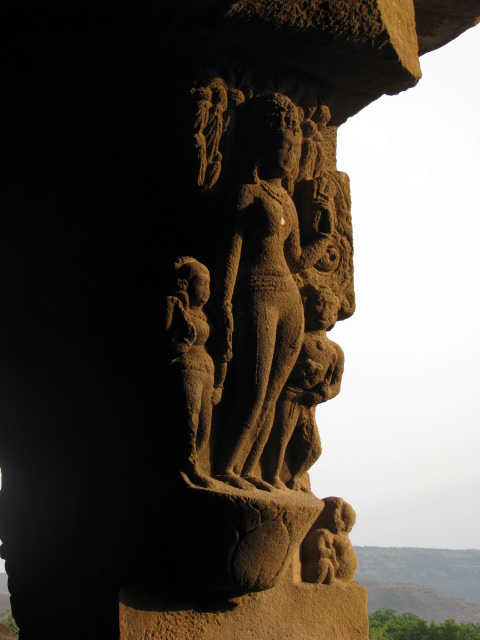
Sculpture in cave 29
The only definite inscriptional evidence is that of Rashtrakuta Dantidurga (c. 753-57 A.D.) on the back wall of the front mandapa of Cave 15. The Great Kailasa (Cave 16) is attributed to Krishna I (c. 757-83 A.D.), the successor and uncle of Dantidurga. A copper plate grant from Baroda of the period of Karka II (c. 812-13 A.D.) speaks about the greatness of this edifice (cave 16). The inscription tells us that this great edifice was built on a hill by Krishnaraja at Elapura (Ellora). Apart from these two inscriptions, the cave complexes lack any other inscriptions.

The entrance to the caves from the car parking opens at cave 16. Also known as the Kailasa cave, it is a remarkable example of rock-cut temples. Its striking proportion, elaborate workmanship, architectural content, and sculptural ornamentation is marvelous. This cave is dedicated to Lord Shiva and named after His mountain home in the Himalayas, the snow-peak Kailasa.

Not-to-be-Missed Caves

Although it's right at the entrance, I am going to start from the beginning to describe the caves. We visited caves 6, 10, 12, 15, 16, 21, 25, and 29. We did not have enough time to visit the Jain caves. Caves 10, 12, 15, 16, 21, 25, 29, and 32 are not to be missed.

Chaityagriha-Cave 10
Cave 6

Cave 6 is a Buddhist cave with two fine sculptures. On the left is goddess Tara, and on the right is Mahamayuri, the Buddhist goddess of learning. A diligent student sits at his desk below.

Row of seated Buddhas in Cave 12
Cave 10

Cave 10 is a magnificent chaityagriha, a place of worship and meditation for the Buddhists. It has a beautiful, ornamental facade. Also known as Visvakarma, it is a typical chaityagriha with stone beams across the ceiling. A seated Buddha is enthroned in front of a large stone stupa in the cave.

Cave 12

Buddha giving his first sermon
Cave 12 is known as Teen Tal, literally meaning three floors. It is three storied, each with a hall with pillars. The walls of the shrine room are lined with five large bodhisattvas, and is flanked by seven Buddhas, representing each of his previous incarnations. It also has a sculpture of Buddha, giving his first sermon depicted by a pair of deer at his feet. The historical value of this cave lies in the fact that human hands built a three-storeyed building from rock with such painstaking efforts and skills that even the floors and ceiling are smooth and levelled. Teen Tala is a monastry-cum-chapel with cells.

Cave 15

Narasimha Avataar coming out of the pillar
Cave 15 is called the Cave of Ten Avatars or Dashavatar. It is a two-storeyed temple having large sculptural panels between the wall columns on the upper floor illustrating a wide range of themes, which include the ten avatars of Vishnu. A panel to the right of the antechamber also depicts the superiority of Shaivism in the region at the time - Shiva emerges from a lingam while his rivals Brahma and Vishnu stand in humility and supplication. One of the sculptures is Shiva as Nataraja.

Cave 15 is the only cave for which you  have to ascend a great many steps, because it is situated at a height. And that's the reason that it is not as frequently visited as other caves. So, if you want to visit cave 15, make sure that there are a few more people with you when you climb in. Going in there all alone is quite spooky. Unlike other caves, it smells of disuse. It's a strange feeling to be all alone with those sculptures all staring at you. And yet, the carvings in this cave are as beautiful as in others. Dedicated to Lord Vishnu, some of the sculptures are really magnificent.

Cave 16

Cave 16, Kailasa cave, is the best of the 34 caves. It is a temple worshiping Lord Shiva and depicts various poses, scenes, and stories of Shiva.

Dhwajastambha
Kailasa has been carved out of a single rock. Kailasa is believed to have been started by the Rashtrakuta king Krishna I. The construction was a feat of human genius – it entailed removal of 250,000 tons of rock, took 100 years to complete and covers an area double the size of Parthenon in Athens.

A two-storeyed gateway resembling a South Indian gopuram opens to reveal a U-shaped courtyard. The courtyard is edged by columned galleries three storeys high. The galleries contain enormous sculptures of various deities.

Gajalakshmi
The first huge sculpture is the Gajalakshmi that you see as soon as you enter the cave. Two life-size elephants cut in rock on each side in the courtyard magnificently guard the cave. The pillars, Dhwajastambhas in the courtyard are intricately carved.

The whole temple consists of a shrine with lingam at the rear of the hall with Dravidian sikhara, a flat-roofed mandapa supported by 16 pillars, and a separate porch for Nandi surrounded by an open court entered through a low gopura. The Nandi Mandap stands on 16 pillars and is 29.3 m high. The base of the Nandi Mandap has been carved to suggest that life-sized elephants are holding the structure aloft.

Mahabharat and Krishna Leela scenes
The temple is a tall pyramidal structure reminiscent of a South Indian temple. The shrine is complete with pillars, windows, inner and outer rooms, gathering halls, and an enormous lingam at its heart – carved from living stone. The temple is carved with niches, pilasters, windows as well as images of deities, mithunas (erotic male and female figures) and other figures. Most of the deities at the left of the entrance are Shaivaite (followers of Shiva) while on the right hand side the deities are Vaishnavaites (followers of Vishnu).

Narasimha Avataar
One of the most remarkable sculptures is the grand sculpture of Ravana attempting to lift Mount Kailasa, the abode of Lord Shiva, with his full might. Some other sculptures include Ravana offering his nine heads to Shiva, Shiva as Nataraj, scene of Shiva-Parvati wedding, Mahishasur Mardini, Mahabharat, Krishna Leela, and Ramayana carvings, Narsimha avataar, Vishnu resting, Tripurantak Shiva, and some other splendid carvings.

Ravana shaking Kailasa
You need at least two hours to see Kailasa. And it definitely is awe-inspiring.

Cave 21

Ramayana scenes
Cave 21 is also known as Ramesvara. It has figurines of goddesses Ganga and Yamuna at the entrance. Cave 21 is thought to be the oldest Hindu cave.

Cave 25

Cave 25 features Surya driving his chariot towards the dawn.

Cave 29

Nataraj in Cave 16
Cave 29 has sculptures of Ravana shaking Kailasa and the wedding scene of Shiva-Parvati. Pairs of lions guard its three staircases. Inside, the walls are covered in large friezes. To the left of the entrance, Shiva slays the Andhaka demon, then defeats the many-armed Ravana's attempt to shake him and Parvati off the top of Mount Kailash. There's also a dwarf baring his bottom to taunt the demon! On the south side, Shiva teases Parvati by holding her arm back as she prepares to throw dice in a game.

Cave 32

Shiva-Parvati wedding
Cave 32 from the Jain caves is known as Indra Sabha. The upper floor has elaborate carvings, including a fine lotus flower on the ceiling. Two tirthankaras guard the entrance to the central shrine. On the right is the naked Gomatesvara, who is meditating deeply in the forest - so much so that vines have grown up his legs and animals, snakes and scorpions crawl around his feet. On the upper level is also seen an imposing image of Ambika, the Yakshi (dedicated attendant deity) of Neminatha found seated on her lion under a mango tree, laden with fruits. We did not have enough time to visit this cave.

Overall, it is a great experience to behold the confluence and spiritual tolerance of three religions. The magnificent structures stand proof to the glorious culture, architecture, art, and painstaking efforts taken by the sculptors in those bygone days.

Grhishneshwar Temple

It is with a heart full of admiration, and the head full of the different sculptures that we come out of the Ellora caves site. It is easy to then visit Grhishneshwar and pay respects to Lord Shiva at one of the 12 Jyotirlingas in India.

Grhisheshwar is still a small temple, yet well-known, and very jagrut. The temple was constructed by Ahilyabai Holkar. It is believed that an ardent devotee named Kusuma offered prayers to Lord Shiva at Grhishneshwar by dipping the Shivalinga in a water tank. Eventually Lord Shiva appeared in front of her and her prayers for the restoration of her son's life were answered.

Back to Aurangabad

With a heart full of devotion to Lord Shiva, you return to Aurangabad for relaxation. Another big day awaits you: a visit to Ajanta.

Wednesday, June 1, 2011

Ennui

It happens once a while. Extreme boredom. Nothing helps. Rather, nothing you do seems to drive away your boredom. Visiting friends does not help. Visiting relatives is doubly taxing. Routine tasks and jobs are tedious and shackling.

It's an overall feeling of dullness and low esteem. And obviously, the reason is unknown.

I am trying to think of some remedies: shopping, movies, pizza party, (re)newed exercise regime, two-days trip, or best, going underground. Let me see if any (or all) might work.

Visiting Daulatabad

The first stop that you can take when you visit Aurangabad is the Daulatabad fort. This fort is around 15 kms from Aurangabad on the Ellora road.

Courtyard of the Daulatabad Fort
A massive land fort, it served as the capital of the Yadav dynasty. Daulatabad is also known as Deogiri and was once considered as invincible. Devgiri is a 12th century fort that was built by the Yadava king Bhillama V. He established the Yadava stronghold in Deccan by making Deogiri as his capital.

Deogiri is a strong land fort and has seven lines of defence. The fort has never seen battles and has seen a change of power only once, and that too through treachery.


High fortified walls with watch towers

On the road to Ellora, when you see the massive Daulatabad fort on your left, you can immediately feel the strength and power of the fort. As you enter the first darwaza, you come across a courtyard

 You cross the courtyard and the second darwaza, and you are met with high fortified walls.


Victory Pillar
As you start walking in towards the fort, you can see the Victory Pillar on your right, also known as Chand Minar. This pillar was raised in 1445 by Ala-ud-din Bahamani to mark his capture of the fort. Chand Minar is 210 ft. (64 m.) high and 70 ft. (21 m.) in circumference at the base, and was originally covered with beautiful Persian glazed tiles.

Opposite the Minar is the Jumma masjid, whose pillars originally belonged to a temple.  Now it has a Devi's mandir. Close by is a large masonry tank, the common bath.  The Chini Mahal lies in ruins and was the place where Abdul Hasan Tana Shah, the last king of Golconda, was confined by Aurangzeb in 1687 AD.

Beyond the main entrance, lie the wet and dry moats, a narrow bridge to cross the wet moat, and the famous Andheri.

The wet moat has small openings from the Andheri, the dark passages. Enemies were thrown directly into the water 30 feet below from the Andheri. It was sheer impossible to cross the wet moat from the narrow bridge and then cross the Andheri.

Andheri

After you cross the narrow bridge, you are led to the dark, dangerous passages that are designed to befuddle, entrap, and finally kill the enemy. The Andheri is a series of secret, quizzical, subterranean passages coiled like a python amidst the fort. In these passages, flaring torches were thrust upon an unwary enemy. Or hot oil poured down his path, as he deliberated in the labyrinth. Heat from a brazier was blown into the passage by a process of suction suffocating the entire garrison within.

Once you are successful in crossing the Andheri with the help of a local guide, you reach the first level of the fort. I suggest that you take the help of the local to cross the Andheri. Not only is it really dark and scary, and you might get lost, but it is also worth listening to the story he tells you as you cross the Andheri. It's chilling and exciting to listen and see the places in the Andheri where the soldiers would be hiding, waiting for the enemy, and the means they would use to destroy the enemy.

In the Andheri, at some places, stone hedges are built so that the enemy walks in the darkness and gets hurt on the knees. The enemy would logically turn to a side with hurt knees only to be banged upon solid stone wall and breaking their heads.

View after coming out of the Andheri
Even with these injuries, if some brave ones are able to move ahead in the labrynth, the hidden soldiers do their work of pouring hot oil on the enemy, or shooting arrows from hidden crevices.

At one point, you can feel the blast of cool air coming and are automatically attracted to it, thinking it's an opening out of the Andheri. But you are mistaken, because that outlet opens directly to the wet moat outside. One step through the opening and you are down the drain, in the water. Fortunately, it is all closed and barricaded now. Can you imagine how many men must have lost their lives in hope of cool, fresh air?


Victory Pillar and the way out seen after coming out of Andheri

After the Andheri, you can keep climbing right up till the top of the fort. We skipped that and returned to the base, because we wanted to cover Ellora too. But the fort was absolutely mesmerizing. It is a standing example of the power, cunning, intelligence, architechtural elegance and excellence that the great Yadav rulers had.


If you plan to visit Aurangabad, do keep time to visit this formidable fort.

Thursday, May 12, 2011

Bibi-Ka-Maqbara

Built in the late 17th century, known as the Taj of Deccan, this mausoleum is a tribute to Aurangazeb's (loving?) wife, Rabia Duram alias Dilras Banu Begum. It was built by her son Prince Azam Shah.

Bibi-Ka-Maqbara in Aurangabad, the Taj of Deccan
Bibi-Ka-Maqbara now stands in the Begumpura area of the Aurangabad city. The area resembles a lot like the Ravivar Peth area in Pune.

Bibi-Ka-Maqbara is another example of the typical muslim architecture. Truly speaking, if you have seen one Muslim architectural building, there's nothing new to see in any of the others. They are just the same...similar outlines, structures, all with minarets, and towers.

With Bibi-Ka-Maqbara, you can start your tour of Aurangabad. Make sure that you reach before sunset. Although the place is open till ten in the night, it is rather dull to look at the huge sturcture in the night because of the lack of proper lightning. With good lights around, the structure should have dazzled and looked beautiful. But with minimum lights, it could be a disappointment in the night.

And after having a look at this, you might decide that after all, it's really not necessary to visit the Taj.

Saturday, April 30, 2011

Visiting Aurangabad

After thinking and researching, and then thinking and discussing, and then again thinking and planning, Sanjeev and I finally decided to visit Aurangabad for our short four-day trip. While researching and discussing, one thing was certain, it was going to be hot, perhaps hotter than Pune. We had chosen such a characteristic hot month to travel to an arid area, that it was bound to be intensely hot and unbearable. Yet, I, more than Sanjeev steeled myself against the harsh heat and set forth to Aurangabad.

Aurangabad lies around 245 kms from Pune in the north-east. On the way to Aurangabad lies Ahmednagar, more popularly called as Nagar. The road through Nagar to Aurangabad is a really very good and is well-maintained. Mostly arid, the landscape is dry and looks parched.

Aurangabad boasts of a rich past. It was ruled by Satvahanas, Yadavas, Tughluqs, Nizams, and Mughals. The amalgamation of all rulers has led to a curious culture in Aurangabad, but it seems predominantly Muslim. Muslim rulers have left their imprints on the city and it is still apparent in the architecture. You will find the famous Taj of Deccan, Bibi-Ka-Maqbara right in the middle of the city.

Aurangabad also has several "Gates" in various parts of the city. You can find the Delhi Gate, Bhadkal Gate, Paithan Gate, and a few others. No wonder it is called the City of Gates.

Daulatabad fort, which should rightly be called the Deogiri fort lies around 17 kms from Aurangabad. And what an awesome fort it is! It was considered impregnable. It was won over by besieging it and not by fighting. That's the greatness of the fort.

Around 10-12 kms ahead of Daulatabad lies Ellora, the world heritage site of Buddhist-Hindu-Jain caves. Beautiful, huge, awe-inspiring sculptures carved out of rocks! Inspite of their hugeness, every minute detail is captured on the sculptures. Each sculpture has a story to tell. Each shows a different emotion.

After Ellora, there's still one place to visit-one of the twelve Jyotirlingas in India-Shri Grhishneshwar. It is a small temple that has a confusing entrance to the main "gabhara." But all in all, it's worth a visit.

Ajanta, another world heritage site lies around 106 kms away from Aurangabad. It's more famous for the paintings in the Buddhist caves than the sculptures. But it is really a wonder of the world that is now slowly fading in the wheel of time.

With Daulatabad, Grhishneshwar, Ellora, and Ajanta, Aurangabad offers sites that can be covered in a three-day visit. But otherwise, the city itself has nothing else to offer. It is a rather poorly-lit city. We were staying in a hotel on the Station Road. After dusk, the city seemed to be lost in darkness. Although pretty crowded, there were no bright street lamps to light the roads. It felt like being in a small town that had nothing much to do.

If you are planning to visit Aurangabad, you can plan your trip for three days. The day you reach, you can cover Bibi-Ka-Maqbara, Panchakki, and local sights in Aurangabad. Use the entire next day for Daulatabad, followed by Ellora, ending with Grishneshwar. Keep at least 5 hours for Ellora and make sure you complete all 34 caves before 5.30 p.m. The third day should be all for Ajanta. You need at least 2.5 hours to reach Ajanta. From the bus base, you are taken to the caves 4 kms inside the mountainous terrain by CNG buses. Again, for the caves, keep aside at least 4-5 hours.

Otherwise, Aurangabad is a pretty sleepy city. Nothing much happening around. Make sure that you take a really good, bright torch with you. Keep enough cash as ATMs might be few. Keep some indoor games like playing cards or board games with you. You can also think of taking your laptop and movies along with you for entertainment in the evening after you have returned from sight-seeng. If you have these tools handy, you should have a pleasant stay in Aurangabad.

Happy Visiting!

See also:

Friday, April 8, 2011

Peths And Sectors

Quite a difference. Seriously!

There I was moving through different gallis and emerging in different peths. And now here I am lost in sectors and numbers.

I am going to try if I can find my way by referring to a sector as Shaniwar Peth and then referring to another sector, say sector number 27 as Sadashiv Peth.

Really muddled!

Friday, April 1, 2011

Candy Desk In US Senate

This piece of "Did You Know" on Wikipedia set me laughing:

http://en.wikipedia.org/wiki/Candy_desk

The article says that there's a tradition in the United States Senate to keep a desk full of candies!

Isn't that awesome? I would love to keep such sweets in my office desk and have a go whenever I want.

Imagine having that in our Lok Sabha or Rajya Sabha. Firstly, free candies would not last more than a minute. If we do assume that they would...there would be a huge hulla-bulla about it from the Opposition Party. They would claim that such candies were kept to defame the MPs, that the government was responsible for answering why such candies were kept there, and why only a particular kind of candies were kept.

For the TV reporters, it would be a field day with "breaking news" about candies in the desk...Who Dunnit? Why? What is the motive? And the news report would be full of pictures of the desk with candies, how those candies are devoured by the MPs, how it's a kind of bribery. There would be late-night or even prime-time shows that discuss the candies in the desk!

I can't stop laughing. Bless the soul who came up with such an idea!

Interestingly, I read this news on the April Fool's Day! More reason to enjoy the candies, I mean the news article.

Breaking News: Overnight Transformation Of City Roads Causes Panic

The city woke up a few days ago to a complete transformation of the roads, causing widespread speculation, wonder, fear, cynicism, and even ...